




























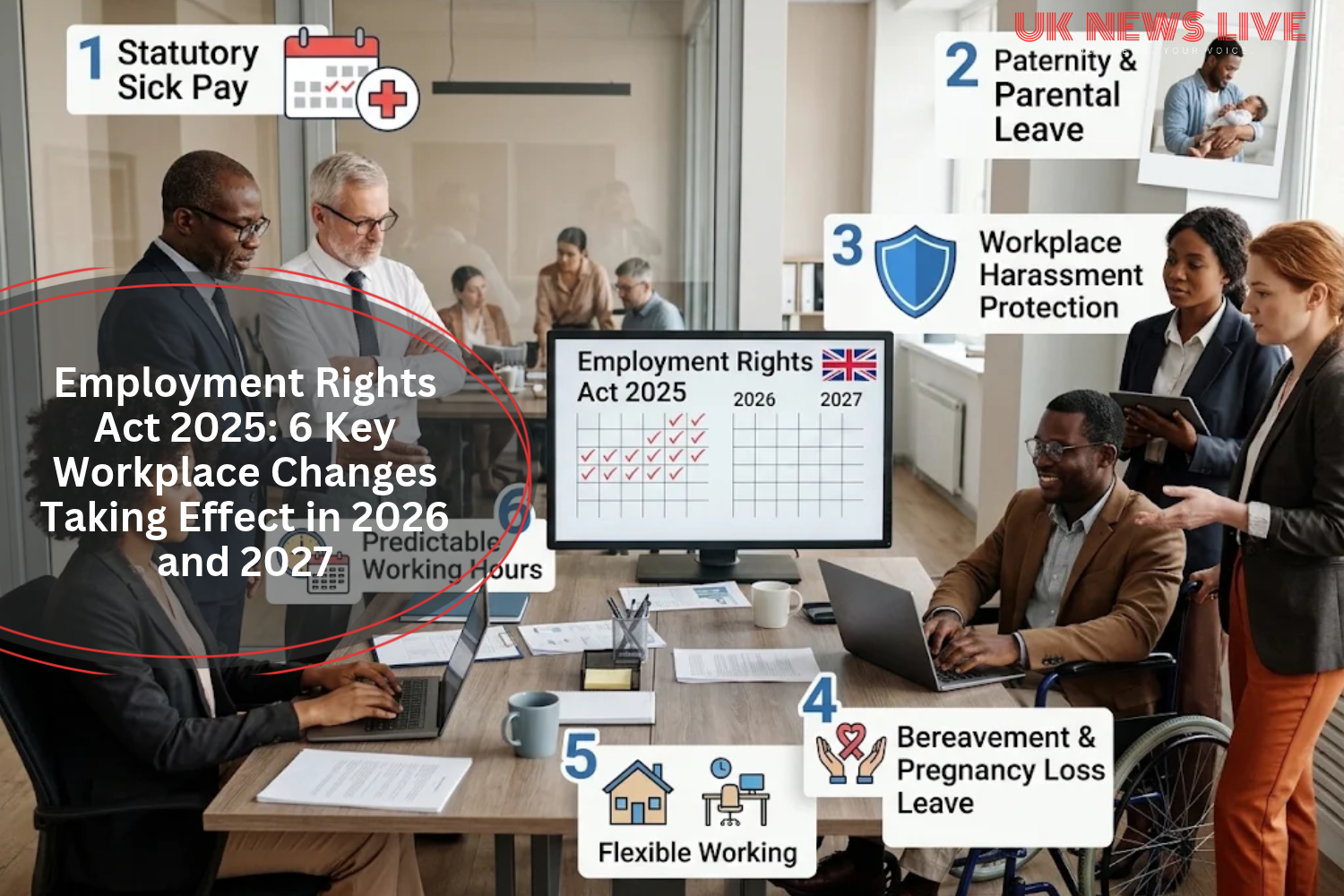
The Employment Rights Act 2025 is introducing significant changes to workplace rights across the UK, with new employment protections taking effect throughout 2026 and 2027. According to the UK Government’s parliamentary statement on employment protections, more than 18 million employees are expected to benefit from these new measures.
Although the Act received Royal Assent in December 2025, its provisions are being introduced in stages, meaning that different changes will come into effect at different times.
These reforms will affect how employees access workplace rights and how employers fulfil their legal responsibilities, covering areas such as statutory sick pay, family leave, workplace protections and working arrangements.
Here are six key changes introduced by the Employment Rights Act 2025, including their implementation dates, what they mean for employees and the responsibilities employers need to understand.
1. Statutory Sick Pay Starts from the First Day of Sickness

The Employment Rights Act removes the previous waiting period for Statutory Sick Pay (SSP), allowing eligible employees to receive financial support earlier when illness prevents them from working.
- Effective date – 6 April 2026: Eligible employees can receive SSP from their first qualifying day of sickness instead of waiting three qualifying days, following the Government’s changes to Statutory Sick Pay rules.
- Updated payment rate: For the 2026/27 tax year, SSP is £123.25 per week or 80% of average weekly earnings, whichever is lower, according to the Government’s Statutory Sick Pay payment guidance.
- Removal of the earnings threshold: Employees no longer need to meet the previous Lower Earnings Limit to qualify for SSP, potentially extending support to more lower-paid and part-time workers.
- Sickness absence statistics: According to the Office for National Statistics’ report on sickness absence in the UK, approximately 148.8 million working days were lost due to sickness or injury in 2025, equivalent to an average of 4.4 days per worker.
- Employee benefit: More eligible workers can receive financial support during sickness absence without the previous waiting period.
- Employer responsibility: Businesses need to update payroll systems, review sickness policies, and ensure managers understand the revised eligibility rules.
2. Paternity Leave and Unpaid Parental Leave Become Day-One Rights

The Employment Rights Act removes previous qualifying service requirements for ordinary Paternity Leave and Unpaid Parental Leave, giving eligible parents greater access to family-related leave.
- Effective date – 6 April 2026: Eligible employees can access ordinary Paternity Leave and Unpaid Parental Leave from their first day of employment, following the Government’s new parental leave rules.
- Paternity leave: The previous 26-week continuous employment requirement has been removed for ordinary statutory Paternity Leave.
- Unpaid parental leave: Employees no longer need to complete the previous one-year service requirement before qualifying for unpaid parental leave.
- Additional parents benefiting: According to the Government’s impact assessment of day-one parental leave rights, approximately 1.5 million additional parents could become eligible for unpaid parental leave.
- Employee benefit: New employees can access qualifying family leave without waiting to complete the previous service periods.
- Employer responsibility: Businesses should update family leave policies, HR procedures and staff handbooks to reflect the new entitlements.
3. Stronger Protection Against Workplace Sexual Harassment

The Employment Rights Act strengthens employers’ responsibilities to prevent sexual harassment and protect employees from inappropriate behaviour in the workplace.
- Effective date – 30 October 2026: Employers must take all reasonable steps to prevent sexual harassment of employees, as explained in the Government’s workplace sexual harassment guidance.
- Third-party harassment: Employers must not permit sexual harassment by customers, clients and other third parties.
- Workplace harassment statistics: According to a Unite the Union survey involving more than 6,000 female members across 19 sectors, 56% had experienced sexually offensive jokes, while 43% had experienced inappropriate touching.
- Other reported experiences: The same survey found that 55% had experienced unwanted flirting, gestures or sexual remarks, highlighting the importance of effective workplace reporting and prevention procedures.
- Employee benefit: Workers have stronger protection and clearer expectations around preventing and reporting sexual harassment.
- Employer responsibility: Businesses should review workplace policies, provide staff training and establish effective reporting and investigation procedures.
4. New Bereavement and Pregnancy Loss Leave Rights

The Employment Rights Act introduces additional statutory leave for employees experiencing the death of a close family member or pregnancy loss. These changes aim to give workers more time to manage difficult personal circumstances.
- Expected implementation – April 2027: New bereavement leave will cover specified close family members, including a spouse or partner, parent, adult child or sibling, as explained in the Government’s announcement on new bereavement leave rights.
- Pregnancy loss protection: Women and their partners experiencing qualifying pregnancy loss before 24 weeks, including miscarriage, will be entitled to up to two weeks of unpaid leave under the new provisions.
- Miscarriage statistics: According to the UK Government’s announcement on pregnancy loss and family bereavement rights, one in five women experience a miscarriage during their lifetime.
- Employee benefit: Workers will have additional statutory time away from work to manage difficult personal and family circumstances.
- Employer responsibility: Businesses should review compassionate leave policies and prepare managers to handle sensitive leave requests appropriately.
5. Flexible Working Requests Will Receive Stronger Consideration
Flexible working has become an important part of modern employment, helping people balance their careers with childcare, caring responsibilities and personal commitments. The Employment Rights Act introduces further changes to how employers consider and respond to statutory flexible working requests.
- Expected implementation – October 2027: Employers will need to consult employees before rejecting statutory flexible working requests and explain why a refusal is reasonable, according to the Government’s flexible working consultation response.
- Existing employee rights: Employees can already make a statutory flexible working request from their first day of employment under the current rules.
- Flexible working statistics: According to the Government’s Survey of Employees and Self-Employed Workers 2024 to 2025, 79% of employees had access to at least one form of flexible working.
- Working arrangements: The same Government survey found that 54% of employees had access to flexible hours, while 40% had access to hybrid working.
- Employee benefit: Employees can benefit from a clearer consultation process and better explanations when their requests are rejected.
- Employer responsibility: Businesses should review flexible working policies and train managers to assess requests fairly.
Technology also plays an important role in supporting flexible employment. Read more about How Technology Makes Being Flexible Possible and Working from Home in the UK: Comforts, Challenges and Surprising Boosts.
6. More Predictable Hours for Zero-Hours and Variable-Hours Workers

The Employment Rights Act introduces new protections for workers on zero-hours and variable-hours contracts, aiming to improve working-hour predictability and income security.
- Guaranteed hours: Eligible workers will have the right to guaranteed hours reflecting their regular working patterns.
- Shift notifications: Employers will need to provide reasonable notice of shifts and changes to working schedules, helping employees organise childcare, travel and other responsibilities.
- Shift cancellation payments: Qualifying workers will receive compensation when shifts are cancelled, shortened or changed at short notice.
- Zero-hours employment statistics: According to Government research on zero-hours and similar contracts, approximately 1.2 million people were employed on zero-hours contracts between October and December 2025, representing around 3.6% of people in employment.
- Unpredictable shift patterns: A Living Wage Foundation study published in September 2026 found that 54% of workers received less than one week’s notice of shifts, while 37% experienced an unexpected shift cancellation in the previous month.
- Employee benefit: Eligible workers could gain more predictable hours, better shift notifications and compensation for qualifying cancellations.
- Employer responsibility: Businesses should review employment contracts, improve rota planning and prepare payroll systems for the new requirements.
Looking Ahead: What the Employment Rights Act Changes Mean for You
The Employment Rights Act introduces important changes to workplace rights across the UK. Whether you are an employee or an employer, understanding these changes can help you prepare for new responsibilities and make informed decisions.
At UK News Blog, we’ll continue sharing the latest employment updates, practical guidance and useful information to help you stay informed.
Get in touch with us to share your insights and help readers better understand their options.
Disclaimer: All information provided was correct at the time of publication and was collected with the help of accredited tools and real-world data insights.